
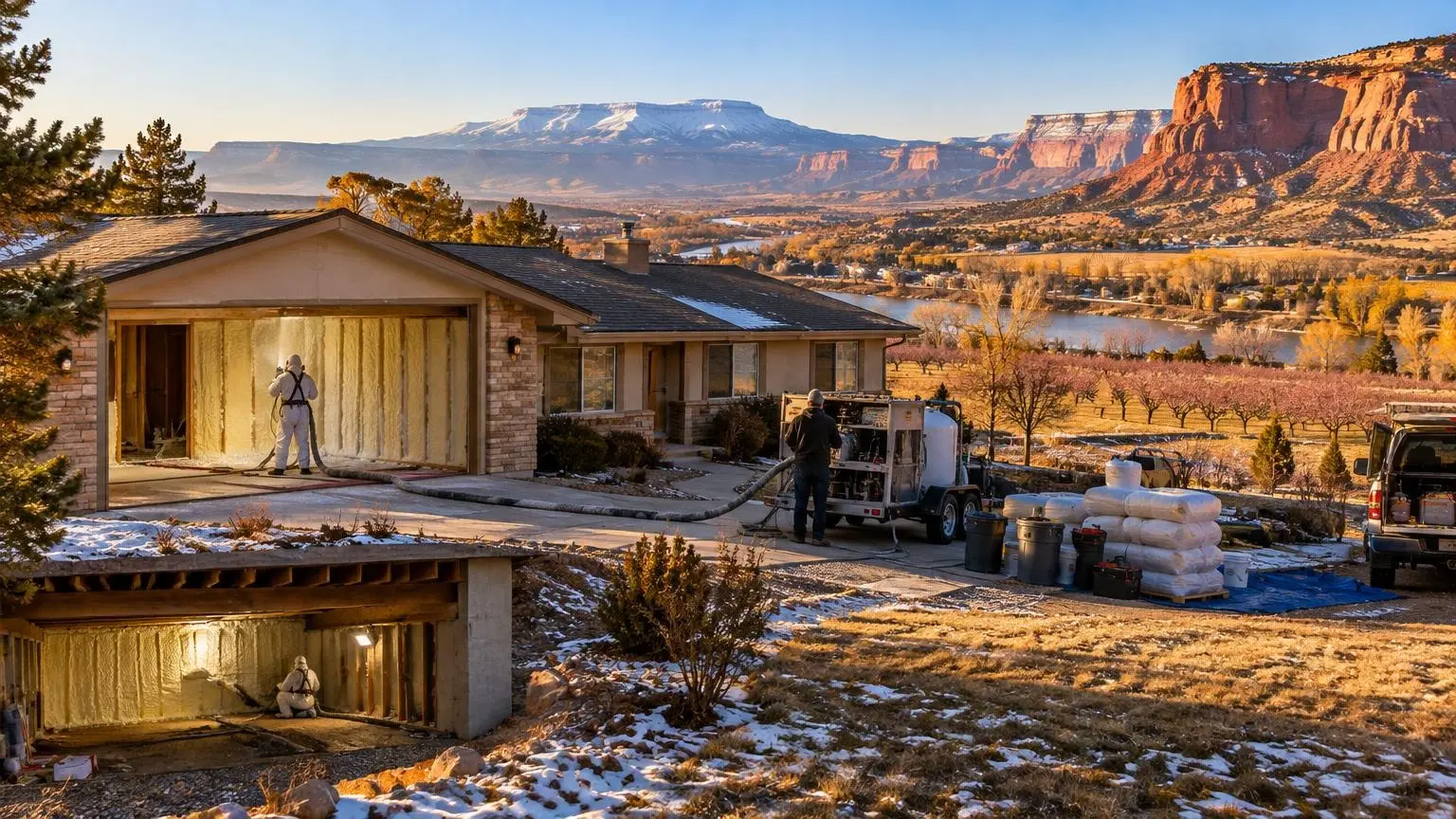
Where the Colorado and Gunnison rivers meet
Spray Foam Insulation in Grand Junction, CO
Cold winters, hot dry summers and every era of house.
- Free on-site estimates
- Foam type, inches and R-value written out per area
- Air leaks, ducts and moisture checked before we insulate
Insulating Homes in Grand Junction
Spray Foam Insulation in Grand Junction works in a cold semi-arid climate at about 4,646 feet. The city's 1991-2020 climate normals list a January mean of 27.4F, about 17.7 inches of snow a year, July highs averaging 94.5F and only about 9 inches of precipitation. The average first freeze arrives around October 11 and the last around April 25, so heating season is long, and the city also averages roughly 68 days a year at or above 90F.
A city of many eras
Grand Junction was incorporated on July 22, 1882, the year after the area opened to settlers, and grew as a farming, fruit-growing and ranching center. The 2020 census counted 29,431 housing units in the city, with a 1.7% homeowner vacancy rate. Older homes near downtown, mid-century ranch houses and split-levels across the middle of the valley, and newer subdivisions on the edges all need different things.
What we usually find
In older houses: little or nothing in the walls, a few inches in the attic and open rim joists over crawl spaces. In mid-century ranches and split-levels: settled blown-in, leaks where split-level rooflines meet, and crawl spaces with fallen batts. In newer homes: decent depth but missed air sealing at kneewalls, chases and duct boots. The quote addresses what we actually find.
The code now
Mesa County began enforcing the 2021 International Energy Conservation Code on September 1, 2025, in line with Colorado House Bill 22-1362. The 2021 IECC base table lists R-60 ceilings for Zone 5. Remodels and additions that need permits will be held to those numbers.
Call (970) 438-0827 to set up a free visit anywhere in Grand Junction.
Grand Junction Climate and Housing Facts
- Cold, dry winters. The 1991-2020 normals list a January mean of 27.4F, a record low of -23F and about 17.7 inches of snow a year (Wikipedia).
- Hot summers. July highs average 94.5F, with a record of 107F and about 9 inches of precipitation a year.
- Long freeze season. The average first freeze is October 11 and the average last freeze April 25.
- Housing units. The 2020 census counted 29,431 housing units, 6.3% vacant, with a 1.7% homeowner vacancy rate.
- 2021 IECC. Mesa County began enforcing the 2021 IECC on September 1, 2025, under HB 22-1362.
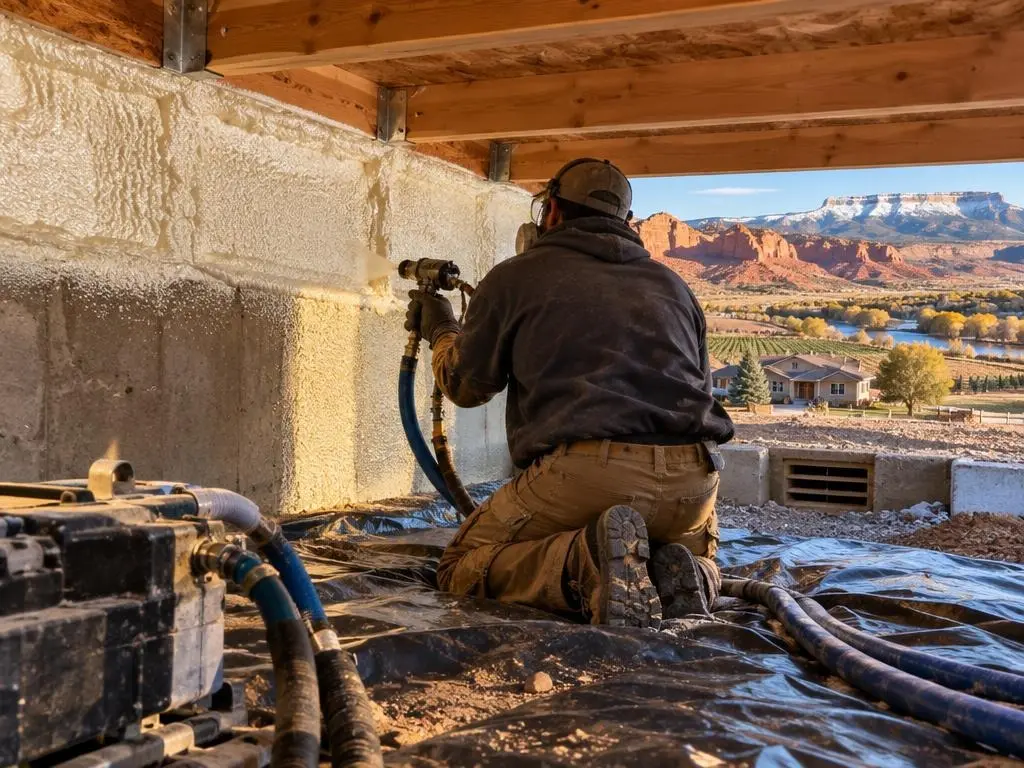
Grand Junction Questions
What insulation does the code require in Grand Junction now?
The 2021 IECC, enforced in Mesa County since September 1, 2025, lists R-60 ceilings and R-30 floors for Zone 5 in its base table.
Is my older Grand Junction home worth insulating?
Usually very much. Older homes often have the most room for improvement in the attic, the rim joists and the walls.
Do you work in all parts of the city?
Yes, from downtown to the north side and the newer subdivisions.
Free Estimates in Grand Junction, CO
Free estimates anywhere in Grand Junction.
Spray Foam Insulation Near Grand Junction
- Spray Foam Insulation in Clifton, CO
- Spray Foam Insulation in Fruitvale, CO
- Spray Foam Insulation in Orchard Mesa, CO
- Spray Foam Insulation in Redlands, CO
- Spray Foam Insulation in Fruita, CO
- Spray Foam Insulation in Palisade, CO
- Spray Foam Insulation in Loma, CO
- Spray Foam Insulation in Mack, CO
- Spray Foam Insulation in Whitewater, CO
- Spray Foam Insulation in Glade Park, CO
- Spray Foam Insulation in Collbran, CO
- Spray Foam Insulation in De Beque, CO
- Spray Foam Insulation in Mesa, CO
- Spray Foam Insulation in Delta, CO